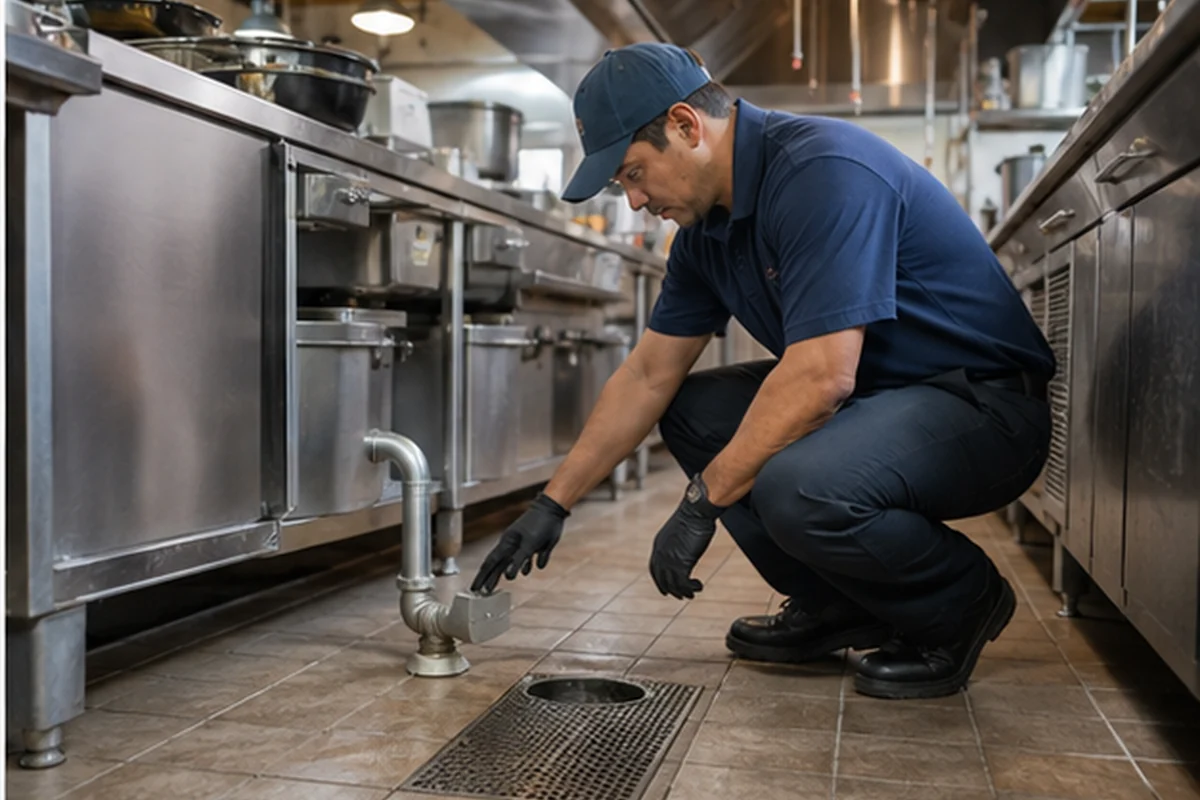
Restaurant Drain and Grease-Line Plumbing Service Intake
- Map every drain zone
- Share cleaning schedule
- Name the manager contact
- Plan shutdown and sanitation
Jacksonville restaurant drain and grease-line plumbing request and commercial service decision
Restaurant plumbing service must fit food operations, drainage zones, grease equipment boundaries, sanitation, shutdown windows, and manager records. A useful Jacksonville plumbing request begins with the affected fixture or area, the observed water or drainage behavior, the time the condition started, whether it repeats, and whether water is actively escaping. The property type, exact address, accessible shutoff, recent work, occupancy, equipment information, and safe photographs help route the visit. Those details support triage; they do not prove a concealed source, material condition, code conclusion, price, or repair result before field inspection.
Riverline Plumbing JAX treats the request as the first page of a fixture-to-route record. The technician should connect the reported symptom to accessible fixtures, branches, valves, traps, drains, cleanouts, heaters, meters, and adjacent finishes without assuming that the closest visible stain or slow fixture is the source. For this service, the initial record emphasizes slow floor or sink drains, recurring kitchen backup, odor complaints, and fixture downtime. The commercial decision is made after inspection establishes a defensible work boundary and the customer reviews what is included, excluded, and subject to change.
- Map every drain zone
- Share cleaning schedule
- Name the manager contact
- Plan shutdown and sanitation
Jacksonville restaurant drain and grease-line plumbing fixture-to-route inspection map
A plumbing system is a connected route rather than a collection of isolated fixtures. Supply water moves through the service, distribution piping, isolation valves, connectors, equipment, and outlets. Wastewater moves from the fixture through traps, branch drains, stacks, building drains, cleanouts, and the downstream connection. Mapping the relevant route prevents a faucet symptom from becoming an automatic whole-house proposal and prevents a recurring downstream obstruction from being treated as a simple fixture blockage.
The inspection record should identify what was accessible, what was operated, what was observed, and what remained concealed. Useful checks for this topic may include zone flow test, cleanout review, camera inspection where useful, and service-history comparison. Results should be tied to a location and condition, with photographs or readings when practical. When a test cannot be completed because of active leakage, unsafe access, tenant restrictions, damaged shutoffs, unavailable utilities, or risk to finishes, the proposal should explain the staged next step instead of presenting uncertainty as a confirmed diagnosis.
- Map the affected fixture and connected branch
- Record accessible isolation and test points
- Separate observed facts from suspected concealed conditions
- Name every inspection limit before pricing work
Jacksonville restaurant drain and grease-line plumbing active water, sewage, gas, and electrical safety boundary
Active water requires calm, property-specific action. Keep people away from wet electrical equipment, ceilings that appear loaded, contaminated drainage, hot discharge, and unstable finishes. Use a known accessible shutoff only when it can be reached and operated safely. Do not cut walls, dismantle a heater, energize wet equipment, enter standing sewage, or attempt an improvised repair based on general website content. Emergency services, the utility, property management, restoration providers, or another qualified trade may be required depending on the condition.
Stopping flow does not complete the plumbing or building recovery. The responsible visit still needs to identify the failed component and connected route, define the repair, test the result, and document materials affected outside the plumbing scope. Water extraction, structural drying, mold assessment, cabinetry, flooring, drywall, electrical work, gas utility work, and hazardous-material handling are separate unless a written proposal expressly includes qualified providers. Clear boundaries protect the customer from assuming that a pipe repair also restores every affected finish.
- Avoid wet electrical and unstable areas
- Use only a safe accessible shutoff
- Report sewage or gas concerns immediately
- Separate plumbing repair from restoration work
Jacksonville restaurant drain and grease-line plumbing diagnosis, testing, and accessible evidence
Diagnosis should reproduce or isolate the condition without creating avoidable damage. Depending on the report, the professional may review fixture operation, drainage response, pressure, temperature, meter movement, visible connections, valve behavior, moisture patterns, cleanout access, camera footage, equipment labels, installation clearances, or prior service records. For this topic, relevant methods include zone flow test, cleanout review, camera inspection where useful, and service-history comparison. No single test answers every question, and a camera image, pressure reading, or moisture indication must be interpreted within the connected system.
The customer should receive a plain explanation of the observed condition, the evidence supporting the proposed repair, and the limits of the inspection. If an intermittent leak does not reproduce, a line is inaccessible, a cleanout is missing, a branch serves multiple units, or a finish hides the route, the next step may be monitoring, additional access, utility coordination, or a separately approved diagnostic procedure. A responsible proposal prices the known step and states the trigger for expanding the work rather than building concealed assumptions into a vague total.
- zone flow test
- cleanout review
- camera inspection where useful
- service-history comparison
Jacksonville restaurant drain and grease-line plumbing repair, cleaning, and replacement scope
The written scope should connect each action to a named component or line segment. For this service, possible work may include drain clearing, camera documentation, localized repair, and scheduled plumbing maintenance. It should state access, isolation, removal, protection, materials, connections, testing, cleanup, disposal, permit or inspection responsibilities when applicable, and any restoration excluded from plumbing work. Product families and methods are not interchangeable; suitability depends on actual dimensions, condition, compatibility, manufacturer instructions, code, water quality, use, access, and the approved design.
Allowance language deserves special attention. A proposal should explain whether camera work, excavation, wall access, concrete work, equipment pads, electrical connections, gas connections, haul-away, disposal, patching, painting, after-hours access, parking, lift equipment, or tenant coordination is included. If conditions discovered after opening can change the scope, define the approval process before work begins. That structure gives the customer a meaningful commercial comparison and prevents a low headline number from hiding necessary stages.
- drain clearing
- camera documentation
- localized repair
- scheduled plumbing maintenance
Jacksonville restaurant drain and grease-line plumbing pipe, fixture, and equipment material compatibility
Material selection belongs to the actual system rather than a marketing preference. The field record may need to distinguish commercial drainage, grease-line components, PVC, and cast-iron transitions. Existing material, age, diameter, temperature, pressure, connection type, support, exposure, water chemistry, manufacturer listing, transition fittings, and future access can change the repair method. A visible section does not always represent concealed piping, and a familiar color or texture does not replace verification where compatibility controls the work.
The proposal should name the material category and connection method when known, while preserving substitutions or design changes that require written approval. Replacing one failed connector may be reasonable when the source is bounded and surrounding material is serviceable. A wider branch replacement, equipment replacement, or repipe should be supported by recurring failures, measurements, widespread material condition, access economics, or a planned property upgrade. Customers should not be pressured into a whole-property project from one symptom without evidence.
- commercial drainage
- grease-line components
- PVC
- cast-iron transitions
Jacksonville restaurant drain and grease-line plumbing bounded repair and expanded project comparison
A bounded repair limits cost and disruption when the source can be isolated, accessed, repaired with compatible materials, and verified. It may remain the best commercial choice even when other aged components exist, provided those observations are documented separately. An expanded project can make sense when multiple failures share a deteriorated branch, a sewer defect causes repeated service, capacity is inadequate, equipment is no longer serviceable, access would be repeatedly destructive, or property plans justify coordinated replacement.
Compare the two paths through evidence, immediate function, recurrence risk, access, material condition, code or permit implications, restoration, operating disruption, expected service life, warranty documents, and the customer’s ownership horizon. The wider option should have a defined route, material plan, phasing, test method, and closeout—not simply a larger price. When evidence is incomplete, staged diagnostics can protect the customer better than either repeated minor work or premature replacement.
- Bounded component repair with a defined test
- Branch or equipment replacement supported by condition
- Staged access when concealed evidence is incomplete
- Whole-property work supported by route and material records
Jacksonville restaurant drain and grease-line plumbing Jacksonville plumbing price and proposal comparison
Jacksonville plumbing pricing depends on the inspection result, service window, access, isolation, line location, material, component availability, equipment, demolition, replacement extent, permit or inspection needs, testing, cleanup, disposal, and restoration boundaries. A price given before those factors are known should be treated as an intake estimate or stated minimum rather than a guaranteed total. The customer benefits most from comparing equivalent scopes instead of isolated headline figures.
Request line items for diagnosis, labor, named materials or equipment, access, protection, testing, permit handling, disposal, and optional work. Confirm deposits, payment timing, change authorization, cancellation, warranty documents, manufacturer registration when applicable, and what happens if the symptom cannot be reproduced. For occupied or commercial properties, include shutdown timing, tenant or manager coordination, food-service restrictions, after-hours access, and the responsible approval contact. A clear proposal makes the commercial decision reviewable before disruption begins.
- Inspection and diagnostic charge
- Defined labor and material boundary
- Permit, access, cleanup, and restoration notes
- Written change and payment process
Jacksonville restaurant drain and grease-line plumbing Florida license, Jacksonville permit, and code review
Before authorizing regulated plumbing work, the customer should verify the contractor or qualifier through the official Florida Department of Business and Professional Regulation license search and match the record to the entity offering the work. A brand, advertisement, uniform, review profile, or website statement is not proof of current authority. The license category, status, business relationship, insurance evidence, and responsibility for permits should be confirmed for the actual project rather than inferred from general marketing.
Jacksonville identifies plumbing permit and inspection contacts through its Building Inspection Division, while the Florida Building Commission publishes current code resources. Permit need depends on the actual work and current requirements; this site does not declare a universal rule. The written proposal should state who evaluates the permit, who applies when required, what inspections or records are included, and which changes await approval. Manufacturer instructions, adopted code, permit documents, and the signed agreement control over general article language.
- Verify the current Florida license record
- Match the business and qualifying party
- Assign permit and inspection responsibility
- Retain approvals and closeout documents
Jacksonville restaurant drain and grease-line plumbing property type, occupancy, and access planning
The same plumbing symptom can require different execution in independent restaurants, commercial kitchens, hospitality kitchens, and retail food sites. Homes may prioritize finish protection and family routines. Rentals require lawful entry and owner approval. Multifamily properties need unit identifiers, shared-line analysis, resident notices, and a manager contact. Restaurants may require sanitation coordination and carefully planned shutdowns. Retail, office, and light-industrial sites may require escorts, operating windows, equipment protection, and facility records.
The request should name the decision maker, occupants, affected and adjacent spaces, utility control, keys or access codes, pets, tenant notice, business hours, parking, loading, elevators, roof or crawl access, and any known hazardous or fragile materials. These conditions affect time and method but do not prove the source. A site-specific access plan reduces interruption and prevents a technically correct plumbing action from failing operationally because the crew cannot isolate water, reach the line, protect finishes, or obtain approval.
- independent restaurants
- commercial kitchens
- hospitality kitchens
- retail food sites
Jacksonville restaurant drain and grease-line plumbing completion testing and customer closeout record
Completion should return to the condition that justified the work. The closeout may include visual inspection, leak checks, pressure or flow observations, drainage testing, camera confirmation, temperature or equipment operation, connection review, cleanup, and photographs as appropriate. A passed test applies to the tested component and conditions at that time; it should not be written as a promise that unrelated concealed piping, fixtures, drainage, utility service, or future use cannot develop another problem.
The customer record should name the component serviced, material or equipment installed, accessible test performed, operating result, unresolved observations, customer instructions, restoration exclusions, permit or inspection documents when applicable, manufacturer paperwork, verified warranty terms, and the trigger for follow-up. For recurring or intermittent conditions, a monitoring plan should state what to photograph or record and when to call. Good closeout turns the visit into a durable property record rather than an unexplained invoice.
- Installed or serviced component
- Material, model, and connection record
- Test result and photographs
- Unresolved conditions and follow-up trigger
Jacksonville restaurant drain and grease-line plumbing Jacksonville service request checklist
To request this service, send the exact Jacksonville address and ZIP, property type, affected fixture or area, symptom, active-water or drainage status, start time, recurrence, safe shutoff information, recent work, prior diagnosis, equipment model when relevant, occupancy and access restrictions, preferred contact, and safe photographs. Do not submit payment data, alarm codes, identity documents, or unrelated sensitive information through the request form.
Riverline Plumbing JAX can then review whether the request fits the stated coverage and which inspection route is appropriate. Coverage, arrival time, emergency response, price, material, permit need, warranty, repair result, and acceptance are confirmed separately in writing. If the condition involves immediate danger, sewage exposure, suspected gas, wet electrical equipment, or unstable building materials, keep people away and contact the appropriate emergency, utility, property, or qualified response resource before relying on an online request.
- Map every drain zone
- Share cleaning schedule
- Name the manager contact
- Plan shutdown and sanitation
Restaurant Drain and Grease-Line Plumbing Service Answers
Restaurant Drain and Grease-Line Plumbing starts with which information?
Send the address, ZIP, property type, affected fixture or area, symptom, active-water status, timing, recent work, access, and safe photographs. Field inspection confirms the source and work boundary.
Restaurant Drain and Grease-Line Plumbing pricing is confirmed at which stage?
Pricing becomes reliable after the condition, access, materials, testing, permit responsibilities, cleanup, and restoration exclusions are defined in a written scope.
Restaurant Drain and Grease-Line Plumbing includes finish restoration?
Only when the written agreement expressly includes that work through qualified providers. Plumbing repair, extraction, drying, cabinetry, drywall, flooring, painting, electrical, and mold work are separate scopes.
Restaurant Drain and Grease-Line Plumbing completion requires which records?
The closeout should identify the serviced component, material or equipment, test result, photographs, unresolved conditions, customer instructions, permit records when applicable, and follow-up trigger.